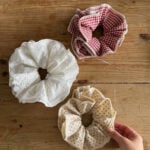
How to Make a Scrunchie the Easy Way
A big, frilly, oversized scrunchie made from two layered rectangles of fabric. No tricky burrito method, just straight lines and a French seam. Beginner friendly and ready in under an hour
Yield: 1 scrunchie
Equipment
- 2 safety pins
- Sewing machine
- Overlocker or overlocking foot (optional) optional
- Rotary cutter and mat (optional, scissors work too)
- Fabric marker or chalk
- Ruler
Materials
- 2 rectangles of fabric, 15cm x 80cm each
- elastic approximately 15cm (but measure to your own hair)
Instructions
- Cut two rectangles of fabric, each 15cm (6") x 80cm (32").
- Take one piece of fabric. Bring the two short ends together and sew with wrong sides facing, using a 1cm (3/8") seam allowance, to create a loop. Trim the seam down to 3mm (1/8"). Fold so right sides are together, enclosing the raw seam inside, and sew another seam at 5mm (1/4") to create a French seam. Repeat with the second rectangle so you have two loops.
- Finish the long raw edges of each loop. If using an overlocker, overlock all four long edges with stitch length and width reduced to the shortest setting. If sewing on a regular machine, use an embroidery or zigzag stitch, or fold the edges down by 5mm twice and sew as normal.
- Place one loop inside the other with wrong sides together, lining up the edges and seams.
- Lay the loop flat and draw two lines along its length using chalk or a fabric marker, each about 6cm in from the edges. Sew along both lines with a straight stitch, leaving a 2.5cm (1") gap on one line for threading the elastic.
- Measure elastic against your hair (as you'd wear the scrunchie), adding 2cm for overlap, and cut to length.
- Attach a safety pin to each end of the elastic. Pin one end near the opening to anchor it, then use the other pin to thread the elastic through the channel. Pull both ends through, overlap by 2cm, and sew together (by machine or hand).
- Close the 2.5cm gap left in the channel by sewing it shut.
Notes
Want a jumbo scrunchie? Cut your rectangles 18cm wide instead of 15cm. For a mini version, go down to 10cm wide and 60cm long. Only the width changes, the method stays the same.